
Three ways to make crochet Christmas baubles: the amigurumi sphere with a round-by-round pattern, mesh-covered...


Find out how to get started without making “false starts” and without wasting time or money.
Hello! I’m Giovanni and I’m one of Tessiland’s marketing experts. I’ll guide you through this short journey to turn your passion into a real business! Follow my reasoning and ask me your questions at the end of the article… I’ll be very happy to answer you!
Who knows how many times you’ve asked yourself: can I turn this passion into a job?
A real dilemma that many people face! Beyond slogans like “do what you love and you’ll never work a day in your life,” we need to come back to reality and understand whether a business activity can truly be combined with a passion for Handmade.
First of all, we need to ask ourselves a few questions:
- How much time can I and do I want to dedicate to this passion?
- How much do I want to invest in this passion?
- Do I want it to become my main job?
- Have I already identified channels to sell my handmade creations?
- Do I want to sell only the finished items or also my know-how?
Let’s analyze it point by point:
How much time should you invest in crochet?
Time is the first real investment and it requires very careful planning. You won’t achieve any lasting result without continuous, proactive work. The first ingredient for success is consistency and rhythm!
Before you begin, learn to consider an editorial calendar with themes, ideas and projects for a medium-to-long period, allowing you to already have some “creative ground” clearly mapped out and then… get to work!
Do I intend to invest in this crochet & knitting passion?
The second point to analyze is whether I have investments I can dedicate to this passion: materials, space, educational resources, equipment, and social/web organization. In fact, you need a minimum level of financial planning so you don’t run out of steam halfway through, and therefore it is useful to create a small “business plan” for what you may need in the medium term, because it is only natural that profits will not arrive immediately: the market is ruthless, full of offers, and it does not wait for us!
You need to create a quality product, one that can be enjoyed by as many people as possible and presented in an original and appealing way.
The first step is choosing reliable suppliers who can ensure continuity and won’t leave us hanging in the middle of potential orders, or who are at least able to provide information on product restocks with a prompt and reliable customer service that answers your questions.
There are so many players on the market, but the choice will be crucial for success and for always having new proposals that can keep us riding the “creative wave”!
Also important, in the historical moment we are living in, is the degree of sustainability with which your preferred suppliers work, and last but not least, the quality and therefore the origin of the products.
Emphasizing a mulesing free or eco-friendly product, a Made in Italy handmade product, has added value that you need to take into account if you want to rise above the crowd and not fight only on price.
Create your own creative corner
Another fundamentally important thing is to set aside a space that is exclusively yours, even a small one, but one that is your creative corner, to be arranged over time with the useful things for your journey, and that also becomes your refuge for relaxation and work.
Your creative corner should then be equipped with possible research and educational materials that can inspire us and that are also motivational (you cannot imagine how important it is to have a pen holder you like with special pens meant only for your own use, or a container that keeps your work tools such as crochet hooks of all sizes and categories, or a few good books to display nicely when meeting potential customers).
Finally, but no less important, the equipment! Yes indeed, equipment that doesn’t have to be overly professional, but that can enhance our creations in the best possible way. Yes, because whether you like it or not, in order to sell, you will need to create images that can showcase your work! First and foremost, a surface on which to photograph your handmade items, a decent light source, and a tool capable of taking decent photos and videos.
Fortunately today, what might seem like the biggest investment is actually the simplest, because we all now have a smartphone capable of taking photos worthy of being published, and for lighting setups there are lamps and light boxes that, for just a few euros, can put us in a position to take almost professional photos.
Once this first step has been taken, it will be necessary to learn how to use some software to create banners and images with text and slogans. There are many of them, both for smartphones and desktop, but one of the most effective remains Canvas.
Practical advice: Canva is a free software for basic functions (which are absolutely not few!) and it will allow you to create banners, graphics and edit your photos without any graphic design skills whatsoever!
Do I want crochet to become my main job?
People often answer yes to this question because they see it as a last resort. Absolutely not! That is not the right approach. If this is to become your profession, it must be with the same motivation and commitment as someone starting their own business, whether it is a café, a newsstand, or a shop!
If you adopt this mindset, you will more easily accept the difficulties that will obviously arise and the sacrifices you will have to face, but you will receive the right reward when you reach your goals because it is scientific: with commitment and dedication, you will make it!
What are the sales channels for my crochet and knitting creations?
Once we have established that we have the fundamental foundations to start the business, we must ask ourselves: where do I sell them? This is certainly not a secondary issue! But there are different solutions to this question: first of all, let us always remember that the presentation of our handmade items is essential: showing that we take care of what we produce increases its value!
So, for example, a crochet pouch will be more appealing if delivered in a nice package, perhaps with our tag, or with a woven “handmade” label, for example, a card explaining its strengths, and in any case finished with care in every detail.
It is important to be able to guarantee that your handmade item was made with quality cord and quality materials, even better if they are Made in Italy. In short, let us create the right emphasis when presenting our creations and guarantee support in case of product issues (going back to the concept that our suppliers must be reliable!).
But where should I sell my handmade creations?
If we followed the advice in the first part of the article, we will also have at our disposal tools and software capable of guaranteeing a quality image of our product, and therefore we can first evaluate some marketplaces: one of the most popular is Etsy for the “handmade” world, but nothing would stop us from using more famous marketplaces such as Amazon or Ebay, for example!
Another solution, among the most appreciated by creative people taking this entrepreneurial path, is “consignment selling through clothing stores.” You can therefore do some research in your city by looking at shop windows to identify who might be interested in a handmade product (and there are many, because it is trendy!!!), and try introducing yourself to find your own customers… but BE CAREFUL: the shop owner is not waiting for you, so presenting yourself with an appointment and with some finished products to show is extremely important!
If we want to be taken seriously, we must present ourselves as professionals who believe in their work and not as hobbyists who are there today and gone tomorrow. We are asking for an investment in our creativity and we must provide guarantees of continuity if the business takes off!!!
Do I want to sell handmade items or also my know-how?
Another very popular topic among enthusiasts. But then, how much can you earn on Youtube if I create a creative channel? Unfortunately, with the spread of social media it is increasingly difficult to reach truly significant earnings, but if they are seen as a “complement” to a main business activity, then they can become interesting.
Earnings will depend on the views of the published projects, so we return to the points discussed earlier: quality images, and explanations that everyone can follow! Creating original projects will not be enough to stand out; it will be an important component, but not the only one needed. Consistency will be required as the first ingredient, along with building loyalty among your followers through content and having a lot of patience!
You will also need to consider working on the most important social media platforms (Facebook, Instagram, Pinterest and TikTok) to spread our BRAND as widely as possible. Yes, because our journey must be preceded by a Brand that identifies us and makes us unique, original, and as little as possible a “copy” of the most famous brands (that would place us at a lower level right from the start… we are unique and we want the world to know it! Much better to use my own first and last name than to imitate famous channels such as the corner of… or handy woman… originality is the first of our goals!
Practical advice: one way to start studying a brand could be Namelix, a free software that, based on some parameters you enter, such as your name, the essential features of what you want to offer, or even a fantasy name, will develop a series of proposals not only for the Brand but also for the graphics of your next Brand! Very interesting!
The tools of the trade to start working professionally with crochet
Another detail that should not be overlooked is using, in addition to the right tools to produce and post-produce your own content, quality tools. Crochet is relaxing, knitting is too, but if we have to dedicate hours and hours every day to these activities, they also become as physically demanding as any manual job! That is why we often read about inflamed nerves, carpal tunnel syndrome and painful shoulders.
How can you solve posture issues when working with crochet?
You should start with a comfortable workstation and perhaps an ergonomic one (there are very comfortable “gamer” chairs available at interesting prices, which allow a comfortable seat and somewhere to rest your arms, and over time that will not be a minor detail!).
Then use tools that make the movement as easy and smooth as possible. Even a very ordinary crochet hook can make a difference, and this has been proven! Those who use this magical little tool only for a few hours can easily make do with the classic aluminum crochet hook that costs just a few cents, but those who use crochet hooks many hours a day will not be able to do without ergonomic, smooth-gliding hooks where even the friction with the yarn is studied in the laboratory!
For example, one of the best crochet hooks on the market comes from a Japanese brand that uses special (and secret!) metal alloys that have made it a true object of desire, along with silicone materials for the handle that have nothing to do with the rest of the tools on the market: I’m talking about CLOVER!
What are the best knitting needles on the market?
The same applies, of course, to knitting needles and circular needles. If we do it as a hobby, we can make do with standard commercial knitting needles which, at a low cost, will allow us to work or take our first steps in the knitting world. But if we want to pursue this path as a job with continuity, then in this case too we will have to evaluate top products that can provide smoothness and comfort.
Without a doubt, one of the most innovative products is the Prym ergonomic needle, which thanks to a special structure, a tip with a truly unique design and an extremely low weight, will provide the highest possible comfort and a 30% faster execution speed compared to a traditional needle, not to mention features such as the ergonomic tip that will ensure you never lose a stitch again!
As for circular needles, the discussion shifts toward Knit Pro, which through its quality and wide range of accessories will allow us to enrich our toolbox over time with interchangeable cables, connectors and various accessories, something that should not be underestimated. Make your choice!
10 strategies to start selling crochet or knitting work
- Define your target audience and develop a specific niche.
- Create a portfolio of high-quality products and present your creations on e-commerce platforms such as Etsy or DaWanda, Amazon or Ebay.
- Develop a social media presence to promote your brand and increase visibility.
- Take part in fairs and local markets to become known to the public and sell your products.
- Offer customized and made-to-measure options for your customers.
- Build relationships with your customers through communication and high-quality customer service.
- Take advantage of collaboration opportunities with other artisans or local stores.
- Develop a strong and professional online presence, with a well-designed website or a good social media page that is updated and proactive.
- Learn the tax rules and how to manage taxes properly to avoid problems in the future.
- Keep improving your skills and learning new techniques so your offer remains current and interesting for customers.
Having a clear idea of what to offer at the beginning
Returning to the first point in the list we have just made, it is at the very least advisable to give a precise identity to our work. Let us identify the basket of creativity we want to offer with clearly defined limits so that we are perceived as professionals (for example, in amigurumi, crochet bags, or trendy knitted garments).
In addition to identifying a reliable supplier, let us also identify the flagship products on which we can offer, for example, different color nuances or textures.
Preparing a winter crochet or knitting collection:
Let us start with classic merino if we want to give an image of quality, perhaps pairing it with a good wool blend and maybe an acrylic microfiber for customers who may request alternatives to animal fibers.
Over time, create a kind of color palette to offer from these products (and in this case a shop like Tessiland is ideal because it sells the product by single ball… so you do not have to face heavy investments at the beginning, also thanks to the shipping that Tessiland has always offered “forever and ever” with just a 19 euro order, which in some cases becomes truly essential! Not to mention the speed of this shop, which allows you to commit to your customers without anxiety.)
Preparing a summer crochet and knitting collection:
A Made in Italy mercerized gassed cotton is definitely the starting point! If it has a wide color chart, even better, and if it also has a competitive price… GREAT! And in this case the most suitable item to start with is definitely IGGY! Over 50 colors of 100% cotton always kept in stock to create everything from garments to amigurumi!
You simply cannot leave the classic Filo di Scozia out of the collection. Also 100% mercerized gassed cotton, but with a much tighter yarn twist that makes it suitable not only for garments but also for accessories such as doilies, gadgets, curtains, jewelry, or runners. In this case the yarn to recommend could be Amanda, a no.5 cotton among the best-selling in Europe and produced exclusively by Tessiland (of course the portal also offers no.8-12-16 and 25 cottons).
Finally, for a need that combines quality with a very competitive price, one could opt for a 100% recycled cotton, still 100% Made in Italy but with an incredible price and a very interesting color chart: DRAKE.
Preparing a fantasy yarn collection for crochet and knitting:
A section dedicated to more fashion-oriented yarns is certainly something we need to consider, and in this case the choices should be made according to your own taste and the style you want to give your collection. We could point out some of the most popular ones and those that could best represent the completion of this handmade “capsule”.
We could recommend a Bucley, airy and in fashionable colors with lurex inserts, which can take center stage in knitwear but also in accessories such as oversized scarves, baktus and stoles.
Perhaps a quality shaded yarn such as Superkate, to satisfy those who seek a color combination that matches their style or outfit, and finally perhaps a more “chic” yarn with sequin inserts for special events such as weddings or elegant dinners, such as SLEEPY.
The choice on Tessiland is enormous and will depend exclusively on the taste of the creative person and the final customer.
Legal obligations and taxation

Do I need a VAT number to sell my handmade items?
Yes indeed, because the little story about occasional work, which sparked the birth of many brands, Youtube channels, and creative businesses, is OVER! Today, if you want to run an activity of any kind, even one that many people consider just a simple household hobby, you must be compliant.
The story of 5,000 euros a year ended at the end of 2021, and from December 2021 the rules changed, and anyone who monetizes (no matter how much) from a Youtube channel or from sales to shops must be compliant.
Even local markets are regulated, but among the maze of provincial and municipal laws there is still some confusion. Still, we must prepare ourselves for the awareness that if you want to sell, you have to be compliant!
So whether it is a VAT number or a sole proprietorship, those will be personal decisions made together with your accountant, but you can no longer pretend nothing is happening without becoming a tax evader.
Let’s analyze some basic concepts for selling our handmade items
Let us start by saying that anyone who carries out a commercial activity that can be defined as “continuous” must open a tax position (VAT number).
On the other hand, if you sell one of your own possessions in a completely occasional way, then no, a VAT number is not required (for example, if we have a chandelier we no longer need and we sell it to our neighbor, then of course no VAT number is needed).
When our handmade items can be defined as works of art (let us imagine making a completely original mosaic painting), and are in any case the exclusive result of one’s own creative ingenuity, and especially when the activity is carried out in a non-professional way (therefore without organization and continuity over time), then even in that case selling with a VAT number is not required.
Here we would need to enter the complex details of the law that distinguishes artistic production in general and therefore distinguishes hobbyists from creative professionals. Put simply, it is enough to know that to be classified as a hobbyist, you create a handmade item starting from existing materials, assembling them, modifying them, and above all you do not do it continuously.
The figure of the creative professional, on the other hand, is identified as someone devoted to making something wholly original, for which even copyright may be claimed.
After this brief clarification (still superficial, because each case would really need to be analyzed individually), the hobbyist is not required to have a VAT number not only because we could define them as a “transformer,” but also because they are not engaged in a continuous and professional activity; it follows that the creative professional, on the other hand, will need a VAT number to sell their works.
Without going any deeper and repeating that these are general considerations that should be applied to the specific case by a professional, 99% of the people interested in selling their handmade items belong to the first category, hobbyists, and that is what my in-depth discussion will focus on.
What are the rules for selling crochet handmade items
Unfortunately, there is no real national law specifically for this activity, but some principles are well established, and that is where we will start:
The value of each single creation or work must not exceed 250 euros (although for this parameter you must bear in mind that regional regulations may state different values).
But let us take this first piece of information as a working reference to “identify ourselves,” and after setting this first boundary, it must be emphasized once again that in order for the activity NOT to fall under tax regimes, it must NOT be continuous and must NOT be carried out professionally, so it must remain an amateur activity.
Once these first criteria are clear, now yes, we can say that you must not exceed 5,000 euros a year in revenue (but in the past this was wrongly considered the only requirement… FALSE! It is only one of many).
You must still issue a non-tax receipt (similar to a traditional receipt and which can be issued by private individuals).
There are pre-printed templates available for completing it, but it is equally possible to create your own printed forms, bearing in mind that the law does not require any revenue stamp to be attached up to the value of 77.47 euros (our old beloved 150,000 lire).
So it goes without saying that above this amount, there is an obligation to apply a 2 euro revenue stamp!
It should also be emphasized that even though the non-tax receipt cannot be considered a true tax document, there is still an obligation to keep them so that you can later complete your income tax return! Yes indeed, because not opening a VAT number does not mean not declaring extra income to the tax authorities.
Generally speaking, if your income (but ALL of it, including any income you may receive as an employee) does not reach 5,000 euros, then an exemption from filing might be possible; otherwise, it must be declared as miscellaneous income (income referred to in Article 67, paragraph 1, letter i) of Presidential Decree no. 917/86, section D of form 730 or section RL of the Redditi PF form), referring to the compensation received from the sale of handmade items.
Selling handmade items at local markets without a VAT number
Another issue we are often asked about. In principle, even without a VAT number, in order to sell at a market, whether small or large, you need to check the municipal rules. In fact, in this case each municipality adopts its own rules regarding the permits required.
In the event of an inspection, you will certainly need to present the substitute declaration in lieu of a sworn statement. This is a declaration that every hobbyist should (MUST) submit to the municipality organizing the event, whether it is a fair, a market, etc.
In some Regions, there is also a requirement to obtain a “hobbyist card”. A sort of “hunting license” (forgive the joke), with regulations as varied as the shape of our territory itself, so it is important to know that it exists, but also necessary to understand whether your region of residence requires it.
ONLINE sales of crochet and knitting creations and handmade items.
For this chapter, there is a great deal of confusion, and even where regulation does exist, unfortunately it is hardly enforced, to the detriment of those who do comply. But here I must explain what is necessary to do, not what actually happens, so:
know right away that online selling, meaning the display of a product accompanied by description, features and price, necessarily requires a tax position! That’s right, you need a VAT number, which must also be clearly visible on your website’s homepage.
So? Can’t I create a website if I don’t have a VAT number?
You cannot do it if you intend to sell your products with a price displayed on an ongoing basis. This is why a website will be possible, but only as a showcase website, to advertise yourself and build an audience before deciding to do it in a continuous and professional way.
Can I sell my creations on marketplaces?
Not to be repetitive, but unfortunately that’s the way it is: Etsy, Ebay, DaWanda, Subito, MissHobby, Amazon or any third-party platform will be absolutely fine for selling your products without a VAT number… UNTIL… your activity becomes continuous. This should make you understand that if you sell something “once in a while,” then you can stay calm, but if you want to build a business there is no escape… the tax authorities are watching you!
Selling handmade objects to stores under a consignment agreement
This is one of the most immediate and quickest practices to make money and also get a certain degree of immediate satisfaction (I mentioned it above).
It basically consists, very simply, in an agreement between a shop owner and a hobbyist who proposes handmade items for a pre-established price, which the shop owner will then resell with a margin. Once the sale is completed, the hobbyist is paid; otherwise, the unsold product returns to the hobbyist with no cost incurred by the shop owner.
In this case too, it is an excellent approach for understanding what direction to take, whether your style appeals to people, whether there is customer response, and above all whether opening a tax position can be sustainable.
Conclusions
As you have seen, there are many things to know if you want to start turning this passion into a real job, and I could not address them all in detail, but I feel like giving my own personal opinion for whatever it may be worth.
In my experience at Tessiland, I have had the privilege of meeting many creative people and enthusiasts, and I can say without fear of contradiction that the only indispensable, most important, essential element for doing anything is commitment.
Believing deeply in your own project will allow anyone to achieve the desired results.
Commitment, dedication and passion will be the ingredients, and no VAT number will ever stand in the way, because even taxes can be beautiful to pay if they then allow us to express our passion, our art, yes because that is what it is, and to receive satisfaction that has little or nothing to do with financial compensation… and then… that will come too!
Best of luck and happy creativity!
Giovanni Mustone.
Further Reading
If you would like to explore the topics covered in more depth
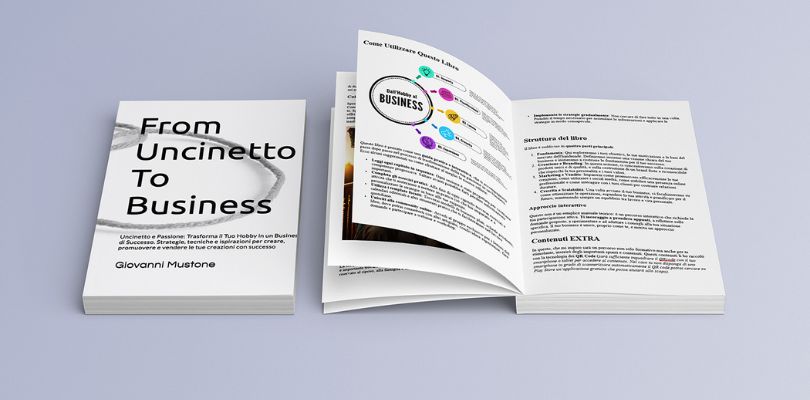
The huge demand convinced me that it was time to create a manual for approaching BUSINESS through this ancient passion that is becoming more and more modern!
The world of crochet is experiencing a true revival. What was once considered a simple pastime is becoming a gateway to exciting entrepreneurial opportunities. More and more creative people are turning their passion for crochet into successful activities, creating personal brands and winning over a community of enthusiasts that continues to grow.
But how do you turn this creative skill into a real and profitable business? How can you take advantage of social media, online selling platforms, and new market trends?
I have gathered all my experience and knowledge into a practical manual that will guide you step by step through this fascinating journey. From pricing your handmade work to creating a distinctive brand, from managing social media to building a loyal community — you will find all the tools you need to bring your entrepreneurial project to life.
Don’t let your passion remain just a hobby. Discover how crochet can become the key to your professional success. CLICK HERE




Leave a comment