
Carrello della spesa
0 prodotti
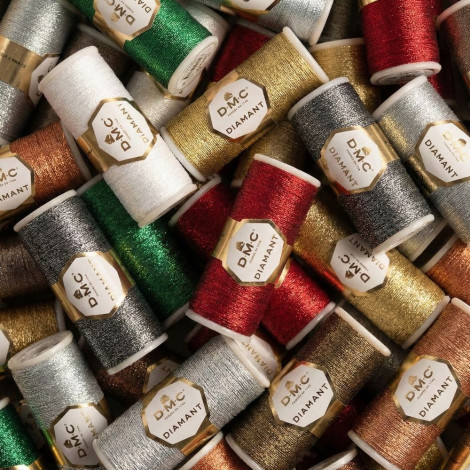
Composite metallic thread 72% Viscose 28% Polyester on a 35 metre spool, non-divisible, with a lubricating treatment for controlled glide. Ideal for hand embroidery, cross stitch, tatting, macramé and textile jewellery. A needle one size larger than the one used for cotton is recommended, with a wide eye.
.png)
First quality products
.png)
Free shipping on orders starting from €19 in ITALY
.png)
You may return the product within 30 days.
QUICK SPECS: Format: Spool | Length: 35 metres | Typical composition: 72% Viscose - 28% Metallised Polyester | Structure: Non-divisible, lubricated | Recommended use: Embroidery, Cross Stitch, Tatting, Textile Jewellery | Recommended needle: +1 size compared to cotton, wide eye
Filo Diamant DMC represents the evolution of metallic threads for hand embroidery, cross stitch, tatting and textile jewellery. Unlike traditional metallics, which are stiff and difficult to handle, this composite thread combines viscose and metallised polyester in a cohesive structure that reduces abrasion and fraying, ensuring an even, long-lasting sparkle. Available on Tessiland with the dye lot number shown directly on the product page, to guarantee maximum transparency in your choice.
With its 35 metres on spool, Diamant DMC has been designed for those seeking a reliable metallic thread for the most demanding techniques: from detailed embroidery to shuttle tatting, from macramé jewellery to luminous outlines in cross stitch. Its technical formula, with a surface lubricating treatment, allows repeated passes through fabric and needle eye without the typical wear of foil-based metallic threads. The composition varies slightly between colour codes (typically 72% viscose and 28% metallised polyester), offering specific characteristics for each shade: some colours are softer and better suited to knotting, while others are firmer and more abrasion-resistant. Tessiland gives you the opportunity to compare available dye lots and, if the lot you need is out of stock, our support team of real people is ready to help you find the best solution for your project.
Diamant quality also at the service of Bijoux
Filo Diamant DMC is not just a decorative metallic: it is a technical thread developed to overcome the historical limits of traditional metallic threads. Its cohesive structure, surface treatment and hybrid composition make it suitable for techniques where other metallics fail because of stiffness, abrasion or poor knot hold. Let us look in detail at the features that determine real performance in your embroidery, tatting and textile jewellery projects.
Classic foil metallics present recurring problems: they break easily, delaminate with repeated use and are too stiff for techniques that require knots or multiple passes. Diamant DMC uses a metallised polymer composite structure that overcomes these limits.
The viscose base (72% in the typical formulation) gives softness, natural drape and more manageable knot behaviour, which are essential features for tatting and macramé. The metallised polyester (28%) supports brightness, improves strength and resists abrasion better during repeated passes through fabric.
The practical result? A thread that maintains the pinpoint sparkle typical of metallics but behaves in a more predictable and reliable way, allowing you to work with more control and less waste. Diamant’s twist and rounder section catch the light from different angles, creating a sparkle effect that works both in embroidery details and in the three-dimensional creations of textile jewellery.
Not all Diamant DMC colours have the same composition. While many keep the standard blend of 72% viscose - 28% polyester, some codes have different formulations: a higher percentage of viscose for softer tones, or 100% polyester for saturated colours that require maximum abrasion resistance.
This variability has concrete effects during work:
If you move from a standard gold to a saturated polyester red, you will immediately notice the difference: the thread will have more spring back and will require tension adjustments, especially in techniques where knot control is critical.
Diamant is sold as a non-divisible thread, and in use it effectively behaves that way. However, the cut end tends to fray, showing the inner strands: this is not a manufacturing defect, but a structural characteristic of composite metallic threads.
Practical fraying management:
The surface lubricating treatment is Diamant’s real strong point: it reduces friction during passes through fabric and needle eye, allowing far more insertions than traditional metallics. This treatment does not wear off quickly if you respect the recommended thread length, but it becomes ineffective if you force passes with damaged tips.
To preserve shine over time, use a needle one size larger than the cotton needle you would use on the same fabric, preferably with a wide eye: passing the thread through a free hole, without scraping against the weave, makes the difference between neat work and a metallic that wears prematurely.
Diamant’s smooth glide, which makes it so pleasant to work with, comes with a trade-off: the friction hold of some starts and finishes is reduced compared with cotton. Traditional techniques need to be adapted.
In hand embroidery and cross stitch:
In tatting (shuttle or needle):
In macramé and textile jewellery:
Classic Diamant has a volume comparable to about 2 strands of mouliné: it gives good coverage but is not a flat thread. In small satin stitch areas, it creates a slight doming that catches light from multiple angles, amplifying the sparkling effect.
Ideal projects:
Projects to assess carefully:
If you are looking for an absolutely flat finish over large filled areas, work with short lengths, use a suitable needle and consider alternating stitch direction to even out the light reflection. For projects where relief is an added value, Diamant expresses its full potential.
To preserve the shine and structure of your work made with Diamant DMC, follow these care tips for the finished item:
How much thread should I cut for embroidery without damaging Diamant?
With metallic threads, the fundamental rule is to work with short lengths. For Diamant DMC, the ideal length is 30-40 centimetres maximum. A longer thread passes through the fabric too many times, increasing abrasion: the result is progressive loss of shine and a tip that frays before the work is finished. It is better to rethread the needle more often than to compromise the quality of the final result.
What needle should I use for cross stitch or embroidery with Diamant?
Use a needle one size larger than the one you would use with cotton mouliné on the same fabric, preferably with a wide eye. The goal is to let the thread pass through a free hole without scraping against the fabric weave: this simple precaution makes the difference between neat, bright work and a metallic that wears out and loses shine. For cross stitch on Aida cloth, if you normally use a tapestry size 24 needle, move up to a size 22.
Can I start embroidery with a loop start as I do with mouliné?
With Diamant DMC, using the loop start technique is not recommended. Diamant is a non-divisible thread: doubling it to create the loop makes it excessively thick and difficult to manage. In addition, the thread’s smooth glide reduces friction hold. Prefer micro anchoring stitches on the back in an area that will later be covered by the embroidery. When finishing, weave the tail under at least 4-5 actual stitches to ensure lasting hold.
Do knots in tatting slip or open with Diamant?
If the tension is too light, this can happen, especially with firmer colour codes (those with a higher percentage of polyester). Diamant’s smooth glide helps the characteristic tatting knot flip, but then the knot must be stabilised with slightly more tightening than with traditional cotton. Always guide the knot closed without a violent snap that could stress the metallic sheath. After the first few knots, you will have calibrated the ideal tension for the colour you are using.
How does Diamant behave with beads and crystals in textile jewellery?
Diamant works very well in textile jewellery, but it requires attention to bead holes. Sharp or poorly finished holes can gradually cut into the metallic coating, especially if the jewellery is worn often. Choose beads with well-finished holes (preferably bevelled) and, for pieces subject to heavy stress, consider securing the final knot with a drop of glue suitable for textiles, especially in colours with a higher percentage of viscose that cannot be cauterised.
Can I burn the end of Diamant to secure it as I do with other synthetics?
It depends on the specific composition of the colour code you are using. In 100% polyester colours, heat sealing with flame may work (always with extreme caution and after testing on a scrap). In viscose-polyester blend colours, no: viscose does not melt like synthetics, it burns and carbonises, creating a fragile and unattractive end. In these cases, the safest finish is to secure the final knot with glue suitable for textiles, allow it to dry completely, and then trim the excess.
Is Diamant suitable for large satin stitch fillings?
It can be done, but it is not its most intuitive use. On large areas, Diamant tends to create a slight doming and requires consistent tension to avoid irregularities. If you want perfect uniformity on large surfaces, work with short lengths (30 cm), use a suitable needle, maintain even tension and consider closely spaced anchoring stitches to prevent the thread from forming bulges. Diamant performs at its best in details, outlines and small fillings where the relief adds dimension.
After how many washes does Diamant lose its shine?
If you follow the care instructions (gentle washing, neutral detergent, no bleach, no direct heat), Diamant maintains its shine for many washes. The surface lubricating treatment is not a coating that washes away easily. The main enemies are aggressive products, excessive temperatures and intense mechanical rubbing in the washing machine without a protective bag. A well-made piece, cared for properly, keeps its sparkle for years.
Why do some Diamant colours seem stiffer than others?
The difference depends on the specific composition of the colour code. Some keep the standard 72% viscose - 28% polyester blend (softer), while others are formulated with different percentages or with 100% polyester to achieve especially bright, saturated and resistant colours (firmer). The 100% polyester colours have greater elastic memory and require more tension control, but offer maximum abrasion resistance. This is not a defect: they are different formulations for different needs.
Can I use Diamant for machine embroidery?
The Classic Diamant on a 35 metre spool is not designed for machine embroidery. The short length, the structure not optimised for embroidery machine speeds and tensions, and the lubricating treatment calibrated for hand work make it unsuitable. For machine embroidery, there are specific metallic threads on large cones, formulated to withstand mechanical stress and the constant tension of automatic frames. Diamant performs at its best in hand techniques where you can control every pass.
Is the dye lot important for Diamant too?
Yes, dye lot matters even for metallic threads. Small variations in the metallising process can create perceptible differences in tone and shine between different lots. If you are making a project that requires more than one spool of the same colour, Tessiland allows you to check the dye lot number directly on the product page, guaranteeing maximum consistency. If the lot you need is not available, our customer support team (real people, not bots) is ready to help you find the best solution for your work.
What should I do if Diamant twists on itself while I embroider?
Twisting is normal in threads with twist, especially when you work with long lengths or uneven tension. To prevent it: work with 30-40 cm lengths, periodically let the needle hang so the thread can untwist naturally, and keep tension even. If the thread twists anyway, do not force it: let the needle hang and the thread will relax on its own under its own weight. Insisting with a twisted thread increases abrasion and compromises shine.