Carrello della spesa
0 prodotti
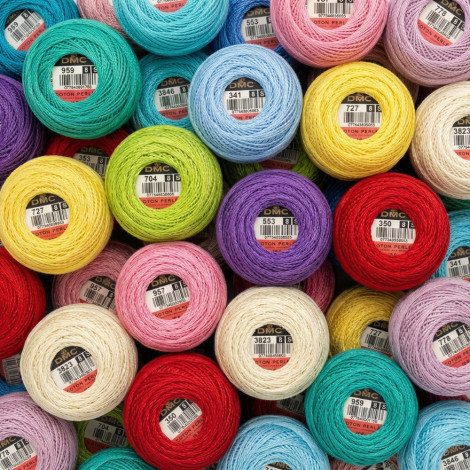
10 gram ball in 100% mercerized twisted cotton with approximately 80 metres of thread. Indivisible hilo for structured embroidery, fine crochet, hardanger and tatting. Recommended crochet hook 1.25-1.50, tapestry needle 22-24 or embroidery needle 5-7. Wash colours up to 60°C.
.png)
First quality products
.png)
Free shipping on orders starting from €19 in ITALY
.png)
You may return the product within 30 days.
QUICK SPECS: Composition: 100% Mercerized Cotton | Weight: 10g | Length: approximately 80m | Crochet hook: 1.25-1.50 | Needle: Tapestry 22-24 / Embroidery 5-7 | Washing: up to 60°C (colours), up to 95°C (whites)
Cotone Perlè DMC n.8 is an indivisible twisted hilo with a round, defined structure, designed to give precision and dimension to traditional embroidery, crochet lace and projects that require clean stitch definition. Available on Tessiland in 10 gram balls with approximately 80 metres of 100% mercerized cotton hilo, this hilo is the well-balanced choice between body and fineness for projects that combine technique and visual impact.
Created for structured embroidery and refined to meet the needs of those who work in counted-thread embroidery, hardanger, tatting and fine crochet, Perlè n.8 stands out for its stable twist that keeps stitch shape even after repeated passes. Mercerization gives it an even sheen, greater strength and rich colours that last over time. With a yield of approximately 80 metres per ball and a construction that reduces fluff and fraying, this hilo is designed for those seeking professional results without compromise: from borders on household linens to tiny textile creations, right through to visible decorative topstitching in quilting. Its silky feel and smooth glide also make it suitable for those approaching techniques such as tatting for the first time, where the readability of the structure helps learning.
Discover some must-see categories you may have missed
The quality of a technical hilo such as Perlè n.8 is not judged by touch alone, but by analysing its construction, finishing and behaviour while working. This twisted cotton is designed to deliver consistent performance in terms of glide, stitch definition, mechanical strength and colour stability: key features for those looking for professional, long-lasting results in embroidery, fine crochet and counted-thread techniques.
The distinctive feature of Perlè n.8 lies in its twisted, indivisible construction: it is not a thread designed to be separated like mouliné, but a hilo that keeps its round, compact shape thanks to its integrated twist. This makes it especially effective whenever you need a clean, readable stitch with slight three-dimensional definition.
The use of long cotton fibres reduces surface fluff and micro-irregularities along the hilo, resulting in sharper embroidery stitches and a neater structure in lace and edgings. Mercerization completes the picture: this tension treatment makes the fibre more even, improves colour absorption and enhances mechanical strength during repeated passes through fabric or stitches.
The result is tangible for anyone working with it: clean lines, well-defined outlines, greater dimensional stability and an even sheen that enhances every stitch without excess. This is not a “soft and flat” hilo, but one that holds its structure and delivers consistent performance in techniques that demand precision.
A technical hilo can also be recognised by how it responds to practical stress: repeated passes through the needle eye, variable tension, friction against the fabric. Perlè n.8 is designed to withstand these conditions without losing definition or sheen.
Its stable twist helps the hilo maintain roundness and body even after many passes: this is especially useful in counted-thread embroidery, where the same stitch may require several passes, and in fine crochet, where the hilo is constantly under tension during stitch formation.
One aspect to consider is natural twisting (kinking): in highly twisted threads it is normal for twist to build up while working. The solution is simple: every 10-15 minutes, let the work hang while holding the hilo, allowing the excess twist to release naturally. This small habit keeps the hilo relaxed and improves smoothness.
As for technical knots, as in any industrial production from cone, joins may occur along the ball. If you find a knot in a visible part of the project, the best choice is not to work it in: cut the hilo and make a neat new join, fastening the ends on the wrong side. This detail makes the difference between a project that is merely “done” and one that is truly “well finished”.
Cotton is a natural fibre and, as such, may show slight colour variations between different lots. For projects that require visual continuity (large embroideries, extended borders), it is advisable to buy everything you need at the same time, checking that the balls belong to the same dye lot.
Tessiland is the only e-commerce store in Italy to show the batch/lot number directly on the product page: this allows you to check availability in advance and, if necessary, contact customer service (real people, not bots) for support with sold-out lots or matching different lots.
With very saturated colours (deep reds, dark blues, blacks), there may be a slight initial colour release during the first wash: this is a natural behaviour linked to excess pigments that are not fully fixed. For high-contrast work (for example dark on white), it is sensible to:
After the first washes, the colour stabilises and the hilo can be treated according to the standard care instructions (up to 60°C for colours, up to 95°C for whites where needed).
The final result with Perlè n.8 depends greatly on the choice of needle or crochet hook, which should match the type of work and personal tension. There are no “absolute” sizes, only reasoned guidelines based on practical experience.
For embroidery:
For crochet:
Pilling is the phenomenon where small fibre balls form on the surface of the work because of friction and wear. It happens when short fibres come out of the hilo structure and cluster together through mechanical rubbing.
Thanks to its combination of long fibres, compact twist and mercerization, Perlè n.8 is naturally low-pilling. Its smooth surface and stable structure reduce fibre release during use and washing, keeping the work neat and tidy over time.
This translates into practical advantages:
To preserve these qualities over time, it helps to follow good care practices: gentle washing, flat drying for structured projects, ironing on the reverse over a soft base so the stitch dimension is not flattened, and storing away from prolonged direct light, especially for intense colours.
Mercerized Perlè is a durable hilo, but its best performance is maintained with a few targeted care steps that preserve sheen, definition and colour stability over time.
← Scroll to see more videos →
For more tutorials, to replace a hilo or calculate the yarn usage for your next creation,
✨ Open Tessiland StudioWhat is the difference between Perlè n.5, n.8 and n.12?
Perlè numbering is inverse in relation to thickness: the higher the number, the finer the hilo. Perlè n.5 is the fullest and gives marked dimension, ideal for highly visible embroidery and statement work. Perlè n.12 is the finest, perfect for tiny details, delicate lace and projects that require maximum lightness. Perlè n.8 sits in the middle and is the most versatile choice: it offers a good balance between stitch visibility and fineness, making it suitable for both structured embroidery and fine crochet, as well as borders and lace with good definition.
Is Perlè n.8 divisible like Mouliné?
No, Perlè n.8 is an indivisible hilo. Its construction is based on an intact twist that guarantees roundness, definition and stitch strength. Trying to separate it weakens the structure, ruins the sheen and compromises the visual result. If you need a finer hilo, the correct choice is to move to Perlè n.12; if instead you need a divisible hilo to adjust thickness, Mouliné is the right product.
What crochet hook size should I use with Perlè n.8?
The standard reference size is 1.25-1.50 mm, ideal for lace, edgings and projects with a defined structure. For textile jewellery, micro amigurumi or very compact work, you can go down to 1.00-1.10 mm. If you work very tightly or want a softer, airier stitch, you can go up to 1.65-1.75 mm. Personal tension has a big impact: always make a test swatch to check the hold and final effect before starting the actual project.
Can Perlè n.8 release colour during the first wash?
With very intense colours (dark reds, electric blues, blacks), a slight initial colour release is possible due to excess pigments not fully fixed: this is a natural behaviour common to cottons dyed in saturated shades. For high-contrast work (for example dark embroidery on white fabric), it is wise to use a colour catcher sheet during the first wash and wash in cool water or at a maximum of 30°C. After the first cycles, the colour stabilises and can be treated according to the standard instructions.
How should I deal with knots inside the ball?
As with any industrial production from cone, technical knots (joins between bobbins) may occur along the ball. If you find a knot in a visible area of the project, the best advice is not to work it in: cut the hilo before the knot and make a clean new join, fastening the ends on the wrong side with neat passes. This detail makes the difference between a project that is simply “finished” and one that is “well finished”, avoiding noticeable bulk or irregularities.
Which needle is best for embroidering with Perlè n.8?
It depends on the type of fabric. On open-weave fabrics (Hardanger, Aida, counted linen), use Tapestry 22-24 needles, with a rounded tip and wide eye, which pass through without splitting the ground threads. On compact fabrics, choose embroidery 5-7 or Chenille needles with a sufficiently wide eye. An eye that is too narrow increases friction, can dull the hilo’s sheen and weakens the twist during repeated passes.
Is Perlè n.8 good for tatting and textile jewellery?
Yes, it is a highly appreciated choice for these techniques. The mercerized surface helps knots glide smoothly and the round twist ensures a full, readable line, which is essential for successful shuttle lace. Its stable structure also makes it ideal for beginners, because it allows the construction of the work to be clearly seen and makes mistakes easier to correct. For textile jewellery it offers strength, definition and elegant sheen without excess.
How many balls do I need for a medium-sized project?
Each ball contains approximately 80 metres of hilo. For edgings on placemats, small accessories or compact embroidery projects, 1 ball is often enough. For larger projects (crochet doilies, extensive embroidery, multiple appliqués), it is best to estimate consumption with a swatch and buy 10-20% more than calculated. If possible, buy everything together to ensure it belongs to the same dye lot, especially when the project requires visible colour continuity.
How do I stop the hilo from twisting while I work?
Twisting (kinking) is natural in highly twisted threads such as Perlè. While working, the twist tends to build up, making the hilo less smooth to handle. The solution is simple: every 10-15 minutes, let the work hang freely while holding the hilo, allowing the excess twist to release naturally through gravity. This small pause keeps the hilo relaxed, improves glide and enhances the overall stitch quality.
Can I machine wash projects made with Perlè n.8?
Yes, mercerized Perlè is machine washable. Colours withstand up to 60°C, whites up to 95°C where necessary. To preserve dimension and sheen as much as possible, especially on delicate embroidery or structured lace, choose gentle cycles, avoid aggressive spinning and dry flat whenever possible. With very intense colours, use lower temperatures (maximum 30°C) during the first washes to stabilise the colour.
Is Perlè n.8 suitable for cross stitch?
Yes, but with one clarification: Perlè n.8 gives a more pronounced dimension than classic Mouliné traditionally used for cross stitch. If you want a traditional, flat and soft effect, Mouliné remains the standard choice. If instead you want cross stitch with more definition, body and a slight three-dimensional effect, Perlè n.8 is a valid alternative, especially suitable on wider-weave fabrics or for decorative projects where dimension enhances the design.
Can I find the same dye lot if I buy at different times?
It is not guaranteed: dye lots vary over time and colour baths run out. For projects that require colour continuity, it is advisable to buy everything you need at the same time. Tessiland is the only e-commerce store in Italy to show the batch/lot number directly on the product page, allowing you to check availability in advance. If a lot sells out, you can contact customer service (real people, not bots) for help managing alternative lots or assessing the visual compatibility of different lots.