Carrello della spesa
0 prodotti
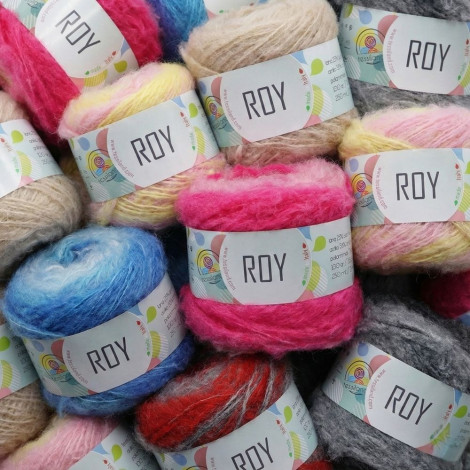
Brushed wool blend in cake format with printed gradient shading in bands, composition 25% wool 58% acrylic 17% polyamide, weighing 100 grams for 250 meters. Recommended needles 5-7 or crochet hook 4-6.
.png)
First quality products
.png)
Free shipping on orders starting from €19 in ITALY
.png)
You may return the product within 30 days.
QUICK SPECS: Composition: 25% Wool, 58% Acrylic, 17% Polyamide | Weight: 100g | Length: 250m | Recommended needles: 5-7 | Recommended crochet hook: 4-6 | Format: Cake | Effect: Brushed gradient
The Roy brushed wool blend yarn by Tessiland is a 100 gram cake that gives you 250 meters of shaded softness with a lightly fluffy effect. Its balanced composition of 25% wool, 58% acrylic and 17% polyamide creates a voluminous yarn perfect for autumn and winter projects inspired by the latest fashion trends.
Discover more options on the Tessiland website
This gradient yarn in cake format features a printed gradient shading in bands that develops naturally as you work, creating sophisticated color effects without needing to change yarn ball. The brushed texture adds volume and character to finished pieces, while the cake structure makes it easier to work with and helps prevent tangling. Available in classic powdery shades and more vibrant tones, Roy suits both elegant projects and youthful, dynamic creations. With 250 meters available and recommended for 5-7 mm needles or a 4-6 mm crochet hook, this yarn lets you create fashion accessories, shoulder garments and decorations with excellent results and superior working comfort.
The technical analysis of Roy yarn reveals the features that make it ideal for contemporary fashion projects. The combination of natural and synthetic fibers, together with the brushed effect and banded gradient shading, creates a versatile yarn with balanced performance in both aesthetics and functionality.
The three-fiber composition of Roy yarn is designed to maximize the benefits of each fiber. The 25% wool provides natural warmth, breathability and the ability to regulate body moisture, essential features for garments worn close to the skin. The 58% acrylic forms the structural base, ensuring strength, dimensional stability and easy care, while also making the yarn more affordable. The 17% polyamide reinforces the structure, improving resistance to abrasion and pilling.
The brushed texture is achieved through a manufacturing process that slightly lifts the surface fibers, creating a velvety, lightly fluffy effect. This treatment gives the yarn visual volume, making it possible to create soft-looking, substantial garments even with simple stitches. The brushed finish also helps disguise any irregularities in tension, making it ideal even for those who are new to crochet or knitting needles.
The cake format presents the yarn wound into a flat cylindrical shape that allows center-pull use, eliminating the problem of a yarn ball rolling around while you work. With 250 meters available per 100 grams, Roy offers a yield of 2.5 meters per gram, placing it among medium-heavy yarns ideal for projects that require coverage and warmth.
The distinctive feature of Roy yarn is its printed banded gradient shading, a dyeing technique that creates color transitions along the yarn length. Unlike random gradients, this method produces repeatable color sequences that form horizontal stripes in flat projects or spirals in round work.
The color bands vary in width and are designed to create visual rhythm: some transitions are quick, generating bold contrasts, while others are more gradual for softer tonal shifts. This alternation gives garments movement without requiring yarn changes or complex colorwork techniques. The gradient develops automatically, following the sequence set by the dyeing process.
For flat projects such as scarves or shawls, the bands arrange themselves parallel to the lower edge, creating horizontal striping. In circular work such as hats or cowls, the effect creates concentric spirals that are especially decorative. The length of each band is calibrated to suit projects of different sizes: small accessories will show quicker transitions, while larger garments will let you appreciate the full color range.
Important for Tessiland: since this is a printed gradient, the starting color position may vary between yarn balls from the same batch. For projects that require color symmetry or the use of multiple cake yarns, Tessiland guarantees transparency regarding the batch/lot number directly on the product page, allowing you to buy yarn balls from the same dye lot. Customer service with real operators is available to assist with color selection and coordination.
Roy yarn is recommended for 5 to 7 mm needles or a 4 to 6 mm crochet hook, a range that allows you to adapt your work to the type of project and desired effect.
With smaller needle or hook sizes (5 mm needles, 4 mm crochet hook) you get:
With larger needle or hook sizes (7 mm needles, 6 mm crochet hook) you get:
Choosing a gauge swatch is essential: making a square of at least 10x10 cm allows you to check that your personal tension, tool size and aesthetic result match your expectations. The brushed texture tends to add visual volume: a slightly softer fabric may look better than an overly tight fabric that flattens the fluffy effect.
The 100 gram / 250 meter cake format and the brushed gradient effect make Roy especially suitable for specific types of projects.
Fashion accessories:
Light shoulder garments:
Decorative projects:
Roy yarn is less suitable for projects that require extremely sharp stitch definition (such as complex lacework) or garments worn directly against very sensitive skin, where the brushed texture may feel slightly rough. For baby garments or people with skin sensitivity, it is advisable to assess individual comfort with a test swatch.
Roy yarn by Tessiland is a cost-effective choice for those who want the fashionable look of brushed gradients without giving up quality. With 250 meters per 100 grams, a single cake can make complete accessories such as standard-size scarves (about 150-180 cm long by 20-25 cm wide with a 5 mm crochet hook) or adult hats with leftover yarn that can be used for matching sets.
The cake format offers both practical and economic advantages:
The blended composition balances performance and cost: the acrylic content keeps the price accessible without sacrificing appearance or comfort, while wool and polyamide add technical qualities that justify a small premium over 100% acrylic yarns. The brushed texture adds perceived value, giving finished projects a refined, on-trend look.
Tessiland guarantees transparency regarding the batch number directly on the product page, a unique e-commerce advantage that allows you to plan multiple purchases with confidence in color continuity. This is especially relevant for gradient yarns, where variations between lots could compromise the harmony of the final project. Customer service with specialized operators is available to help with yarn quantity calculations and any repeat purchases.
Roy brushed wool blend yarn requires specific care to preserve the brushed texture and the intensity of the gradient over time:
← Scroll to see more tutorials →
For more tutorials, to replace a yarn or calculate the yardage for your next creation,
✨ Open Tessiland StudioHow many grams of Roy are needed for an adult scarf?
For a standard scarf measuring about 160-180 cm in length and 20-25 cm in width, you generally need 1-2 cake yarns of 100g, depending on the crochet hook or needle size used. With a 6 mm crochet hook or 7 mm needles (a more open fabric), a single cake may be enough, while with smaller tools (4 mm crochet hook, 5 mm needles), which create a denser fabric, you may need 150-200 grams. The advantage of the cake format is that one yarn ball lets you complete a large part of the project while maintaining gradient continuity.
Can Roy yarn cause itching or irritation?
Sensitivity to Roy depends on individual tolerance. The 25% wool composition is generally well tolerated, but the lightly fluffy brushed texture may feel less comfortable on very sensitive skin or for those who are intolerant to wool. It is recommended to make a test swatch and wear it against the skin for a few hours before committing to larger projects. For accessories such as scarves or hats worn over other garments, comfort is generally excellent.
How does the gradient behave in circular projects?
In projects worked in the round such as hats, cowls or sweaters worked from the bottom up, Roy’s banded gradient creates a highly decorative spiral effect. The color transitions develop helically rather than in parallel horizontal stripes. The final effect is dynamic and modern, especially appreciated in beanies where the spiral converges toward the top. The width of the bands determines the frequency of the spirals: projects with many stitches per round will show softer spirals, while narrower work will create tighter spirals.
Is Roy yarn suitable for baby projects?
Roy can be used for baby projects such as blankets, soft toys or decorative accessories, but it requires careful evaluation for garments in direct contact with a newborn’s delicate skin. The brushed texture and the presence of wool may feel slightly rough for some babies. For baby garments, it is preferable to make a swatch and assess comfort, or reserve Roy for projects such as stroller blankets, nursery decorations or accessories for older children with less sensitive skin.
Can I combine cake yarns in different colors within the same project?
Yes, combining Roy cake yarns in different shades is an excellent technique for patchwork projects, square blankets or color-block garments. The different colorways maintain the same brushed texture, ensuring aesthetic consistency. For projects that alternate colors, it is advisable to check the batch number through Tessiland to make sure all cake yarns have identical spinning characteristics. Customer support can assist with selecting harmonious combinations from the different available palettes.
Does Roy cake shed fluff while working?
Like all brushed yarns, Roy may release a small amount of surface fibers during the first stages of working and the first washes, which is normal because of its fluffy texture. This shedding is generally limited and stabilizes after the first wash. To minimize fiber release, avoid excessive tension while working and handle the garment gently. The polyamide in the composition helps anchor the fibers, reducing the issue compared with 100% natural brushed yarns.
How do I calculate the yarn needed for a triangular shawl?
Triangular shawls have progressive yarn consumption: the first rows require few meters, while the last rows require much more. For a medium-sized shawl (150-180 cm wingspan), you generally need 2-3 cake yarns of 100g (500-750 meters total), depending on stitch density. Openwork stitches use less yarn than solid stitches. To make the most of the gradient, it is advisable to start from one end of the color sequence and let the transitions develop toward the shawl opening, creating an ombré effect from top to bottom.
Is Roy yarn suitable for amigurumi?
Roy is usable for amigurumi with a few considerations. The brushed texture gives toys a soft, bulky look, but it can make details less defined, such as embroidered eyes or small appendages. It is ideal for large amigurumi with simple shapes (teddy bears, decorative cushions), where the fluffy texture adds character. For small amigurumi with many details, it is better to choose smooth yarns that provide greater precision. The gradient effect creates especially decorative toys without the need for color changes.
Does every cake start from the same point in the gradient?
No, because it is a printed gradient, the starting color position may vary between different cake yarns even within the same batch. This is normal for gradient yarns and is not a defect. For projects that require color symmetry (for example, two identical sleeves or coordinated panels), you can contact Tessiland customer service for assistance in selecting cake yarns with similar sequences, or plan the project by treating these variations as an element of uniqueness and personalization.
Can Roy be machine washed?
Although the acrylic and polyamide content provides durability, machine washing is not recommended in order to preserve the brushed texture, which is the distinctive value of this yarn. Mechanical washing tends to flatten the fluffy effect and can cause felting in the wool component. If absolutely necessary, use a delicate wool cycle in cold water (max 30°C), placing the garment in a protective mesh bag, but hand washing remains the safest choice for maintaining the original appearance and volume over time.
How can I prevent the cake from collapsing while working?
The cake format is designed for center-pull use, but it can occasionally collapse if emptied quickly. To prevent mess: pull the yarn from the center of the cake rather than from the outside, place the cake in a bowl or container to keep it stable, and avoid pulling too forcefully, which could collapse the internal structure. If the cake loses its shape, you can rewind it temporarily into a traditional yarn ball for the final portions, or continue working despite the mess, as it does not affect the quality of the yarn.
Is Roy suitable for jacquard or intarsia work?
Roy is not ideal for jacquard or intarsia techniques that require clean, controlled color changes. The automatic gradient effect makes it impossible to predict exactly which shade you will be working with at any given moment, compromising the precision required for geometric designs. Roy is instead perfect for projects that enhance continuous color: simple stitches that let the transitions develop naturally, raised textures that interact with the color bands, or techniques such as half double crochet shawls that emphasize vertical ombré.