Carrello della spesa
0 prodotti
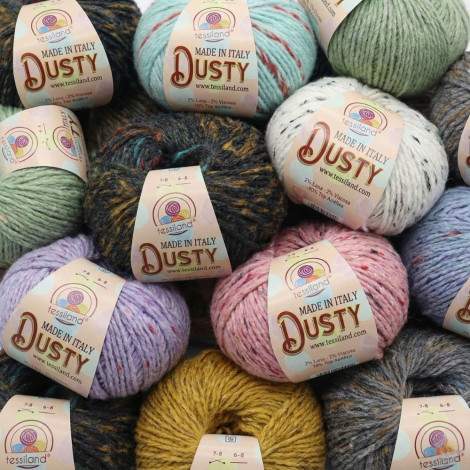
Super-soft 50g ball with 75 metres and a dusty shaded effect, made of 70% Top Acrylic, 21% Polyester, 5% Polyamide, 2% Wool, 2% Viscose. Works up with 7-8 mm needles or 6-8 mm crochet hook for garments and accessories with a modern, refined look.
.png)
First quality products
.png)
Free shipping on orders starting from €19 in ITALY
.png)
You may return the product within 30 days.
QUICK SPECS: Composition: 70% Top Acrylic, 21% Polyester, 5% Polyamide, 2% Wool, 2% Viscose | Weight: 50g | Length: 75m | Recommended needles: 7-8 | Recommended crochet hook: 6-8 | Effect: dusty shaded
Dusty by Tessiland is an innovative yarn that redefines the concept of shading in the world of knitting and crochet yarns. Thanks to its multi-fibre composition and technical structure that 'sets' colour inserts into a base framework, this 50g ball creates an exclusive dusty effect, perfect for trendy garments and accessories with a contemporary look.
Dusty’s extraordinary softness comes from the balance of Top Acrylic (70%), Polyester (21%), Polyamide (5%), Wool (2%) and Viscose (2%): a carefully designed blend that ensures lightness, warmth and a sophisticated colour result. With 75 metres in length and a weight of 50 grams, this yarn works with 7-8 mm needles or a 6-8 mm crochet hook, making it ideal for maxi pullovers, cardigans, ponchos, oversized scarves, baktus shawls and cowls. The dusty shaded effect gives projects a refined look that is hard to replicate, perfect for those who want to stand out with forward-thinking creations. On Tessiland, you will always find the available batch/lot number clearly indicated: for multi-ball projects, our team is ready to help you ensure colour consistency and personalised support.
When melange can make the difference
Dusty is an advanced technical solution for anyone looking for a yarn that combines performance, innovative aesthetics and ease of use. Its multi-fibre structure and dusty colour effect make it a strategic choice for projects that need soft volume, refined shading and reliable shape retention. Let’s take a closer look at the features that set it apart.
Dusty’s blend combines five different fibres, each with a specific role in the final result:
This synergy creates a yarn with a soft, enveloping and silky feel, ideal for pieces worn directly against the skin such as cowls and oversized scarves, yet structured enough for cardigans and ponchos with strong visual impact.
Dusty’s 'dusty' effect comes from a spinning technique that sets colour inserts into a dominant base colour, creating delicate shading that never feels harsh. Unlike traditional shaded yarns with sharp transitions, Dusty produces a soft, harmonious gradient, as if the colour had been lightly dusted over the surface of the ball.
The practical result:
This effect makes every garment unique and hard to replicate, enhancing handmade craftsmanship and helping artisanal creations stand out.
With 75 metres per 50 grams, Dusty offers a yield of 1.5 metres per gram, typical of soft, voluminous yarns suited to larger needle and hook sizes (7-8 for needles, 6-8 for crochet hooks). This translates into:
For multi-ball projects such as maxi pullovers or wide ponchos, Tessiland always indicates the batch number on the product page: if a lot sells out, our team can help you find the same batch or suggest project strategies for combining different lots with harmonious results.
Dusty excels in projects where texture and colour interact to create visual impact. Recommended uses include:
For more structured projects such as bags or cushions, Dusty can be paired with firmer yarns in contrasting colours to create mixed textures full of personality.
Working with Dusty requires attention to yarn tension and stitch choice to bring out the dusty effect without weighing down the fabric:
Dusty does not require aggressive blocking: a light steam finish at the end of the project is enough to even out stitches without flattening the volume.
To preserve Dusty’s softness, dusty colour effect and durability, follow these care instructions:
← Scroll to see more tutorials →
For more tutorials, to replace a yarn, or to calculate the yarn needed for your next creation, try
✨ Open Tessiland StudioHow many Dusty balls are needed for a women’s size M cardigan?
For a women’s size M cardigan made with Dusty (assuming a length of around 60 cm and long sleeves), you will need approximately 10-12 balls of 50g, equal to 750-900 metres in total. The quantity varies according to the stitch chosen: lace or airy stitches require less yarn, while denser stitches such as stockinette use more. We always recommend making a 10x10 cm swatch to calculate your personal gauge and ordering 1-2 extra balls from the same batch for safety.
Is Dusty suitable for summer projects or only for autumn-winter?
Dusty is mainly an autumn-winter yarn thanks to its multi-fibre composition (70% Top Acrylic, 21% Polyester), which ensures warmth and volume. However, it can also be used for light spring accessories such as lace shawls or evening shoulder wraps, worked with airy stitches and a large crochet hook to maximise breathability. For full-body summer projects, we recommend cotton or linen yarns from the Tessiland range.
How can I combine balls from different batches without visible breaks?
If you need to use balls from different batches, use these strategies: alternate the batches every 2 rows/rounds to gradually blend tonal differences; place batch changes in less visible areas such as under the sleeves or at the sides; create intentional geometric sections (for example, body in one batch, sleeves in the other) to turn the variation into a design feature. Contact the Tessiland team: we can check the availability of your batch or advise you on the best project solutions.
Does Dusty tend to pill after washing?
Dusty has good resistance to pilling thanks to the presence of Polyester (21%) in the blend, a fibre known for reducing fuzz formation. However, like all multi-fibre yarns with an acrylic component, it may show slight surface pilling in the early stages of use, especially in high-friction areas (underarms, sides). To minimise it: wash at 30°C on a delicate cycle, avoid aggressive spinning, and remove pills with a manual or electric lint remover.
Can I use Dusty for amigurumi crochet projects or does it need finer yarns?
Dusty is not ideal for traditional amigurumi, which require finer yarns (2-3 mm crochet hook) for defined details and compact fabric. With a 6-8 mm crochet hook, Dusty creates a more open fabric, suitable for oversized amigurumi or large decorative plush projects where the dusty effect adds character. For classic amigurumi, Tessiland offers baby cottons and acrylics with higher yardage and 2.5-3.5 mm sizes.
Does Dusty’s dusty effect stay even throughout the work?
Yes, the dusty effect is built into the yarn structure and remains even throughout the entire length of the ball. Unlike hand-dyed yarns that may show variations, Dusty ensures colour continuity within the same ball. For multi-ball projects, it is important to use balls from the same batch (indicated by Tessiland on the product page) to ensure consistency from one ball to the next.
Is Dusty suitable for beginners or does it require advanced experience?
Dusty is also suitable for beginners thanks to its softness, which makes it easy to work with, and its dusty effect, which enhances even simple basic stitches (single crochet, garter stitch). The 7-8 mm needles and 6-8 mm crochet hook allow projects to grow quickly, which is motivating for beginners. The only thing to watch is yarn tension: avoid pulling too tightly so you do not compress the yarn’s natural volume. We recommend starting with accessories such as cowls or baktus shawls to build confidence.
How can I calculate the number of balls needed for a 180 cm long oversized scarf?
For an oversized scarf measuring 180 cm long and 25 cm wide in Dusty, using an airy stitch such as ribbing or moss stitch, you will need around 4-5 balls of 50g (300-375 metres in total). The quantity varies depending on the width you want and your personal tension. Indicative formula: (length cm × width cm × 0.8) / 75 metres = number of balls. Always make a 10x10 cm swatch to check the yield of your stitch and add 1 extra ball for safety.
Can Dusty be worked together with other yarns for two-tone effects?
Absolutely yes! Dusty works beautifully in two-tone projects or mixed textures when paired with solid-colour or neutral yarns. Recommended pairings: dusty Dusty + white/cream cotton for a bright contrast; Dusty + solid merino wool in coordinated shades for texture play; Dusty + fine lurex yarn held double for glamorous touches. Make sure the paired yarns have compatible yardage (around 60-80 metres per 50g) to maintain a consistent drape.
After how many washes does Dusty keep its softness and colour?
With proper care (washing at 30°C, delicate cycle, flat drying), Dusty keeps its softness and colour intensity for more than 20-30 washes. The Polyester in the blend ensures colour fastness, while Top Acrylic and Polyamide preserve the structure. Avoid harsh detergents, bleach and tumble drying, which could speed up wear. To refresh softness after repeated washing, a light steaming can help reopen the fibres.
Is Dusty suitable for children’s garments or are there more suitable yarns?
Dusty can be used for children’s accessories such as scarves, hats and cowls thanks to its softness. However, for garments in prolonged contact with sensitive children’s skin, we recommend 100% natural yarns or certified baby acrylics from the Tessiland range, specifically tested for children’s use. If you choose Dusty for children, opt for projects with flat outer seams and wash the garment before first use to soften the fibres further.
Which crochet stitches best enhance Dusty’s dusty effect?
The stitches that best enhance the dusty effect are those that create texture without covering the yarn too much: single crochet for compact yet defined fabrics; half double crochet for a balance between coverage and lightness; fan or shell stitch for textured volume that highlights the shading; granite stitch or popcorn stitch for three-dimensional texture that catches the light on dusty tones. Avoid stitches that are too openwork, as they would disperse the yarn’s colour impact.