
Carrello della spesa
0 prodotti
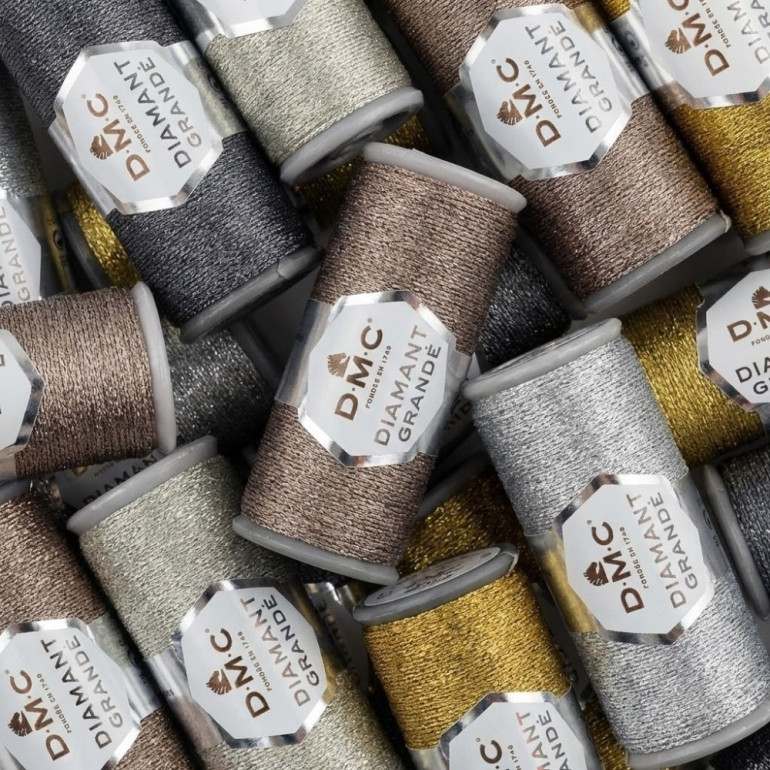
DMC Diamant Grandé is a metallic thread designed for hand embroidery and cross stitch, perfect for bright, jewel-like details. Thicker than classic Diamant, it gives stitches greater presence and a brilliant finish on canvas and fabrics. Also suitable for jewellery making and techniques such as tatting, crochet and macramé; recommended crochet hook size 1. Composition 72% viscose and 28% metallised polyester, on a 20-metre spool.
.png)
First qualità products
.png)
Free shipping on orders over €19 in Italy and €59 in Europe
.png)
You may return the product within 30 days.
QUICK SHEET: DMC Diamant Grandé (Art. 381) is a metallic thread for hand embroidery and cross stitch, designed for bright “jewel-like” details. Non-divisible construction with 6 braided strands, thicker than classic Diamant: it covers more and gives the stitch more presence.
Length: 20 meters | Composition: 72% Viscose + 28% Metallised Polyester (some specific shades may be 100% Polyester) | Structure: 6-ply non-divisible | Recommended crochet hook: 1.00 (1.25–1.75 can be used depending on tension) | Recommended needle: Cross-stitch Tapestry 22–24 (adequate eye) | Washing: hand wash, lukewarm water, mild detergent.
With metallics, the issue is always the same: you either get shine or you get ease of use. DMC Diamant Grandé was created to reduce that trade-off. It’s a “high-impact” metallic thread: thicker than standard Diamant, non-divisible and compactly built to deliver coverage, relief and an even reflection on canvas and fabrics. It performs very well in hand embroidery, in cross stitch that isn’t overly dense, and—outside embroidery—in techniques where you need a metallic that can handle tension: tatting, jewellery crochet, braids and decorative details.
Grandé works best when you want a visible sparkling line, with a stitch that stays round and “full”. It’s not a thread to force on every fabric: on very dense fabrics or with tight needle eyes, friction increases and the metallic finish wears faster.
A metallic isn’t judged by “does it shine or not”: what matters is how it’s built, how it slides, how much twist it accumulates and how it handles the real friction of needle and fabric. Diamant Grandé is designed to be more manageable than traditional thin-film metallics—provided you follow its rules.
Grandé is a 6-ply non-divisible thread: the strands are braided into a single body. Result for you: no time wasted separating and re-aligning, a more “puffy” stitch and a more even reflection than metallics that open up and get messy.
The viscose base contributes softness and flexibility; metallised polyester provides shine and surface durability. Result for you: less “foil-like roughness” and a more consistent behaviour through the needle eye.
The thread performs well when friction is controlled. On very dense fabrics (Aida 18) or with a narrow needle eye, wear increases and the metallic surface may dull. Result for you: choose a needle with an adequate eye and don’t force the holes—this preserves shine and continuity.
Its thickness is roughly double standard Diamant and its coverage is comparable to multiple strands of cotton floss. Result for you: on bright accents and decorative lines you save passes and get visible relief.
Metallics build up twist during use. If you work with very long lengths or don’t release twist, knots and “bird nests” increase. The cut end may open up—this is normal for a soft twist. Result for you: short lengths, release twist, and tidy the end when needed.
With metallics, length is the #1 cause of surface wear. Beyond 50 cm, friction through the eye and “stress” on the coating increase. Better to change often than to ruin the thread halfway through.
Every 5–6 stitches (or whenever you feel the thread “twisting up”), let the needle and thread dangle: gravity releases twist and reduces knots and tangles.
If the end frays and it’s hard to thread, seal it with a micro-drop of clear nail polish or fabric glue, let it dry, then thread. Alternatively use a flat-plate needle threader.
On Aida and cross-stitch fabrics use a Tapestry 22–24 with an adequate eye. If the hole is small (Aida 18), don’t push it: you may distort the fabric and wear the metallic finish.
For crochet the reference is 1.00, but many work more smoothly with 1.25–1.50. If stitches are too stiff, go up a size; if they lose firmness, go down. With beads, check the hole first: 1 mm often works, but it depends on the bead.
Metallic shine is best preserved by avoiding mechanical rubbing and harsh detergents. Even if the thread is stable, it’s wise to treat it as a delicate finish.
Standard Diamant is thinner and better for fine details and dense fabrics. Grandé is thicker, covers more and gives a fuller, more 3D effect with a single thread. If you stitch on Aida 18, it usually makes more sense to stick with standard Diamant.
No. It’s a non-divisible thread: the 6-strand structure is tightly braided. Splitting it weakens the thread and worsens the evenness of the shine.
It’s not recommended. Small holes increase friction: you may distort the fabric and wear the metallic finish. It performs better on Aida 11–14 and stitches more cleanly.
Usually for two reasons: the length is too long and twist has built up. Cut 40–50 cm and let the needle and thread dangle every few stitches to release twist.
Seal the end with a micro-drop of clear nail polish or fabric glue and let it dry. Alternatively use a flat-plate needle threader and trim off the already “worn” section.
A Tapestry 22–24 with a comfortable eye. The goal is reducing friction: a too-narrow eye means faster wear of the metallic finish.
Yes, especially for jewellery: it handles knot tension well and gives a strong metallic look. If you want more shape “memory”, some shades (depending on composition) can feel a bit stiffer—useful for structured motifs.
Better to avoid it: the metallic area suffers from mechanical action and rubbing against other garments. Prefer gentle hand washing and flat drying.