Carrello della spesa
0 prodotti
.png)
First qualità products
.png)
Free shipping on orders over €19 in Italy and €59 in Europe
.png)
You may return the product within 30 days.
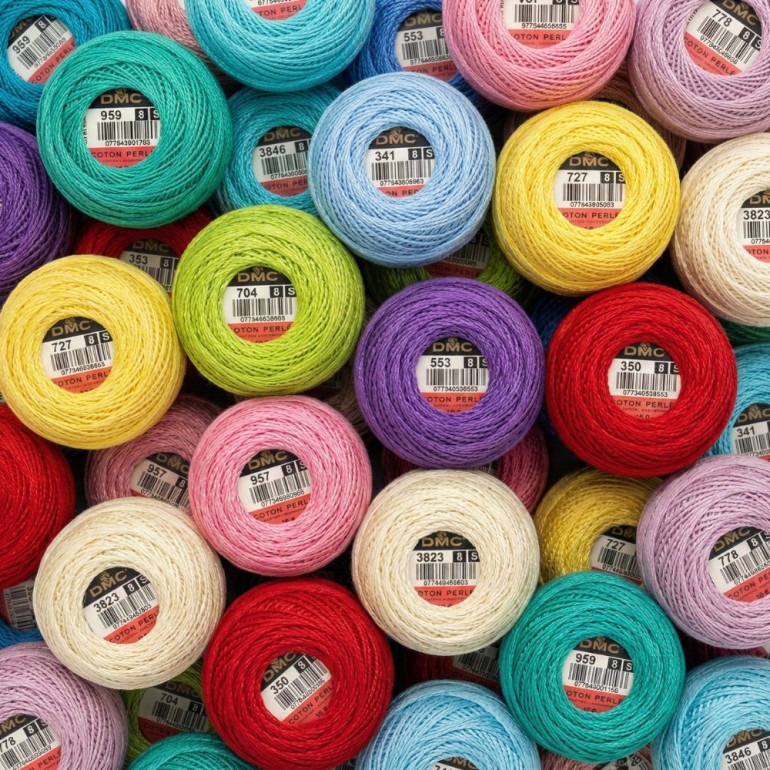
QUICK SHEET: DMC Perlè No. 8 ball (Art. 116) in 100% cotton, twisted and mercerized, a non-divisible high-definition thread for embroidery and crochet.
Weight: 10 grams | Length: approx. 80 meters | Composition: 100% Cotton | Recommended crochet hook: 1.25–1.50 | Recommended needle: Tapestry 22–24 / Embroidery 5–7 | Washing: up to 60°C (colors), up to 95°C (whites).
DMC Pearl Cotton No. 8 is one of those threads you can’t “sum up” in two lines: you understand it when you work with it. It’s a twisted, round, non-divisible thread designed to deliver stitch clarity, readability, and durability. Size No. 8 is the most balanced choice if you want a visible yet refined line: it bridges the gap between a fuller No. 5 and a more delicate No. 12, making it ideal for both structured embroidery and crochet lace and edgings.
The difference with Pearl Cotton No. 8 lies in its construction: it isn’t a “soft, flat” cotton, but a thread that holds its shape. That’s why it’s especially loved when you want a neat, readable result: from counted-thread embroidery to fine crochet details, where thread regularity translates into cleaner work.
With cotton threads, quality isn’t measured only by how it feels in your hand, but by how the thread was built and finished. Pearl Cotton No. 8 is a stable industrial product designed to deliver consistent performance: smooth flow, definition, strength, and color performance.
Longer fibers reduce surface fuzz and the number of micro-discontinuities along the length of the thread. Result for you: crisper stitches (especially in embroidery) and less visual “noise” on lace, edgings, and details.
Pearl Cotton is a twisted, non-divisible thread: it’s not meant to be separated like stranded floss. The twist is part of its look—stitches stay round, don’t flatten out, and don’t “split” easily.
Result for you: clean lines, well-drawn outlines, and a slightly three-dimensional effect on fabric.
Mercerization is a tension treatment that makes the fiber more uniform and more receptive to dye. Result for you:
In any industrial production there can be technical knots (joins between cones). “Zero knots” can’t be guaranteed. In good-quality Pearl Cotton the frequency is usually low, but it can happen.
Expert tip: if you find a knot in a visible area, don’t stitch over it—cut and redo a clean join, securing the tails on the back. In embroidery and lace, a neat join is what makes the work look “professional.”
Cotton is a natural fiber: small differences between dye lots are possible. For large projects, it’s best to buy everything at once. With highly saturated colors (deep reds, dark blues, blacks), you may see minimal initial bleeding on the first wash—this can be a normal behavior of excess pigment.
Best practice: for high-contrast work (e.g., dark on white), use a color catcher sheet on the first wash and wash in cool water or up to 30°C for the first cycles.
Pilling forms when short fibers work their way out of the twist and clump due to friction. The combination of twist and finishing makes Pearl Cotton low-pilling.
Result for you: embroidery that stays clean and an edging that keeps its definition even after wear and washing.
Size 1.25–1.50 is a solid reference, but personal tension matters a lot. For stiff, compact work (jewelry, micro-amigurumi) you can go down toward 1.00–1.10. For standard edgings and lace stay between 1.25 and 1.50. If you have a very tight tension or want more softness, you can go up to 1.65–1.75.
With highly twisted threads, it’s normal for twist to build up while you work. Simple method: every 10–15 minutes, let the project hang while holding the thread—excess twist releases naturally and the thread returns to a “relaxed” state.
A needle eye that’s too small increases friction, can dull the sheen, and stresses the twist. On open-weave fabrics (Hardanger/Aida) use Tapestry 22–24; on dense fabrics choose Embroidery 5–7 needles or Chenille needles with a large eye.
If you need to change thread or color, avoid visible knots. It’s better to secure the tails neatly on the back: the work stays clean and avoids stiff spots or odd bulk.
Mercerized Pearl Cotton handles washing well, but best results last longer with good habits:
The numbering is reversed: the higher the number, the thinner the thread. No. 5 is thicker (more relief), No. 12 is very fine (tiny details), and No. 8 is the most versatile middle ground for embroidery and crochet.
No. It’s a non-divisible thread. Its look depends on the intact twist: splitting it weakens the thread and ruins its roundness and definition.
On average 1.25–1.50. For jewelry or very compact micro-work, go down to 1.00–1.10. If you want a softer stitch or have tight tension, you can go up to 1.65–1.75.
With very intense colors, slight initial bleeding is possible (normal). On light backgrounds, it’s wise to use a color catcher sheet and wash at low temperature for the first cycles.
If you find a knot in a visible area, avoid stitching over it. Cut and redo a neat join on the back: it’s the cleanest and most durable solution.
On open-weave fabrics (Hardanger/Aida) use a Tapestry 22–24 (blunt). On dense fabrics choose Embroidery 5–7 needles or Chenille needles with a large eye, so the thread glides without stress.
Yes. The mercerized surface helps knots slide and the twist gives a bold, highly readable line. It’s also a great choice for beginners who want to clearly see the lace structure.
One ball contains about 80 meters. For edgings and small accessories, 1 ball is often enough; for larger projects, estimate with a swatch and buy 10–20% extra, preferably from the same dye lot.
← Scroll to see more videos →