Carrello della spesa
0 prodotti
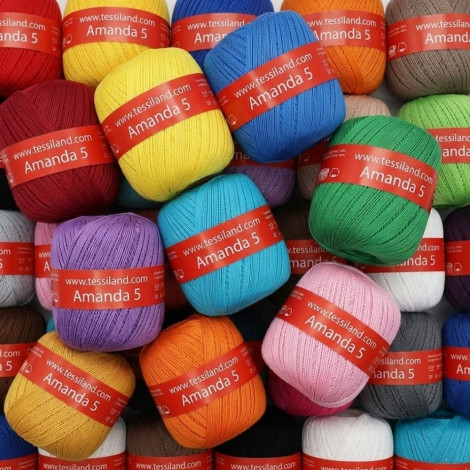
Cotton lisle ball in 100% cotton n.5, weighing 100 grams with a length of 260 metres. Recommended needles 2-2.5 or crochet hook 1.5-2.
.png)
First quality products
.png)
Free shipping on orders starting from €19 in ITALY
.png)
You may return the product within 30 days.
QUICK SPECS: 100% long-staple cotton ball, tightly twisted, mercerised.
Weight: 100 grams | Length: 260 metres | Recommended needles: 2-2.5 | Recommended crochet hook: 1.5-2.
Amanda 5 is a Filo di Scozia in 100% long-staple cotton, designed to deliver strength, shine and dimensional stability. It’s a n.5 count (thicker than n.8): it works up faster, holds stitches well and gives a crisp, clean finish, with the “firm” hand typical of tightly twisted mercerised cottons. Perfect for doilies and table runners, and also highly effective for summer garments and accessories when you need a defined, long-lasting stitch.
Amanda 5’s key strength is the balance between a medium thickness and a compact twist. That means less risk of the yarn “splitting” under the hook and it’s easier to keep your tension consistent. If you crochet a lot, smooth glide matters too: with the right tools(1.5–2.0 mm), your rhythm stays even and stitches look crisp.
A mercerised cotton can look similar to many others “in photos”. Over time, the real difference comes from fibre length, twist and finishing. Here’s what truly affects the performance and durability of Amanda 5.
Choosing long fibre reduces the amount of short, weaker fibres that tend to work their way out and wear down. What that means for you: better tensile strength (useful for borders and tight stitches) and less loss of definition after washing.
Mercerisation increases light reflection and improves dye affinity. What that means for you: deeper, brighter colours and a “clean” look that stays stable—especially on home pieces that are washed frequently.
The tightly twisted construction is designed to stay compact. What that means for you: the hook enters the stitch without splitting the yarn, and chains don’t fray when you work quickly.
A well-stabilised cotton tends to keep its size and shape. What that means for you: placemats, runners and summer garments that don’t “shorten” unexpectedly after the first wash (as long as you respect temperature and drying).
Because it’s thicker than a count 8, the finished piece will feel fuller and slightly heavier for the same project. If you work with a hook that’s too small (below 1.5 mm), the fabric can become dense and stiff, with reduced drape. For garments, it often works better with a 2.0 mm crochet hook if you have tight tension.
To preserve shine and hand feel, wash at 30-40°C with a gentle detergent. Avoid bleach and harsh drying. Dry flat or well spread out, away from direct sun: on whites it helps reduce yellowing; on dark colours it limits fading. For intense shades, on the first wash you can add a pinch of salt to help stabilise brightness. If the project is lacy, a light steam press (with a protective cloth) improves stitch clarity.
← Scroll to see more videos →
For more tutorials, to substitute a yarn, to calculate the yarn needed for your next make, try
✨ TESSILAND STUDIOBecause it combines the classic Filo di Scozia look (shine and crisp stitches) with an easy-to-work thickness: it grows quickly and doesn’t require “micro” tools like finer counts.
Amanda 5 is thicker (260 m/100 g), so it’s faster and more structured. Count 8 (around 450 m/100 g) is finer and better for lace and very delicate details.
Yes: the compact twist supports even stitches, and count 5 adds body without losing definition. For very lacy runners, always make a swatch.
As a guideline, 2 balls of 100 g, depending on lace density, width and edging.
Yes, but keep in mind that cotton holds water when wet. A tight stitch is best and, if needed, add a lining for comfort and stability.
No, the structure is designed to stay compact. If you notice splitting, it’s usually a combination of an overly “sharp” hook and uneven tension.
For garments, try 2.0 mm to get more softness and drape. For doilies and edging, 1.5–1.75 mm keeps the design more “sculpted”.
Yes: it’s a plant-based, breathable yarn suitable for contact with the skin. As with any cotton, avoid harsh detergents or too much fabric softener if you’re sensitive.
Yes, on mid-gauge machines (4.5 mm or above), always testing glide and tension before starting the garment.
Yes—especially if you want a shiny, “clean” result (not fuzzy). For firm shapes, use tight stitches and evenly distributed stuffing.
Compared to a count 8, yes—it can feel fuller and slightly heavier. For summer tops, choosing lace or granny-style stitches helps balance it out.
Cut and weave in ends with a blunt tapestry needle: run the tails through stitches for a few centimetres, avoiding bulky knots in visible areas.