Carrello della spesa
0 prodotti
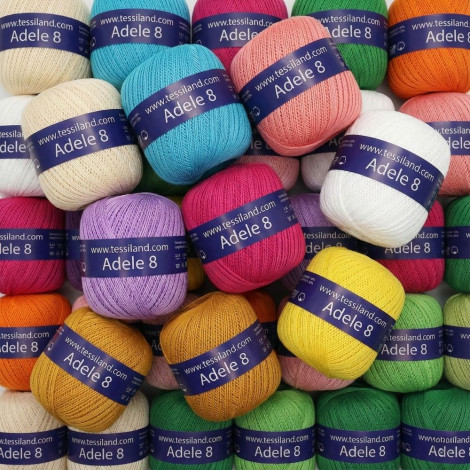
100% mercerized and gassed Cotton Lisle ball, 100 grams for 450 meters, 8/3 construction with three tightly twisted plies. Recommended needles 2-2.5 or crochet hook 1.0-1.75 for precision work such as doilies, filet crochet and tatting.
.png)
First quality products
.png)
Free shipping on orders starting from €19 in ITALY
.png)
You may return the product within 30 days.
SCHEDA RAPIDA: Composition: 100% Cotton Lisle | Count: 8/3 (three tightly twisted plies) | Treatments: Mercerized and Gassed | Weight: 100 grams | Length: 450 meters | Recommended needles: 2-2.5 | Recommended crochet hook: 1.0-1.75
Adele Cotton Lisle n.8 represents the gold standard in mercerized cotton for high-precision work. With 100 grams and 450 meters of length, this technical yarn delivers outstanding yield for doilies, filet crochet, tatting and embroidery. Available on Tessiland with guaranteed transparency on dye lot/batch number—crucial for projects that require perfectly consistent color.
Made from carefully selected long-staple cotton fiber and treated with double mercerization and gassing in line with Italian textile tradition, Adele n.8 stands out for its 8/3 structure: three plies tightly twisted with a closed twist. This technical build ensures a strand that won’t split during fast stitching, delivering crisp, readable, geometrically perfect stitches. The smooth, glossy surface—achieved through controlled thermo-chemical treatments—glides effortlessly on fine crochethooks (1.0-1.75) and 2-2.5 needles, reducing hand fatigue even during long sessions. Ideal for anyone seeking a yarn that combines high technical performance, long-term dimensional stability, and a sheen that enhances every openwork or textured stitch.
Adele Cotton Lisle n.8 is not just a shiny hobby cotton: it’s the result of a technical textile supply chain that starts with long-staple fiber selection and ends with precise thermo-chemical treatments. Each ball contains structural and performance features that determine how it behaves while you work and how it lasts over time. Understanding these details helps you choose confidently and achieve professional results.
The term Cotton Lisle refers to cotton that undergoes double mercerization in caustic soda baths at controlled temperature and concentration. This process permanently changes the fiber’s cellular structure, making it rounder and more compact. The practical result? A light-reflecting surface with an even shine, 20–30% higher tensile strength compared to raw cotton, and improved dye affinity that produces deep, stable shades.
The subsequent gassing step removes remaining micro-fuzz by passing the yarn quickly over flame. This creates a perfectly smooth strand that won’t snag your hook and avoids the dull halo typical of non-gassed cottons. For openwork like filet crochet or tatting, this surface cleanliness is decisive: every ring, picot and negative space stays crisp and easy to read.
Adele n.8 features a technical 8/3 construction: three cotton plies twisted together with a tight, closed, balanced twist. The 8 indicates the metric count (weight-to-length ratio), while the 3 identifies the plies that make up the finished yarn. This architecture is purposeful: the closed twist prevents ply separation during fast stitching—an issue common in loosely twisted cottons.
Practical effects while working:
• The hook glides without splitting the strand
• Stitches keep uniform thickness even with tight tension
• No fraying or opening when passing through picots
• Geometric stitch definition stays stable even after repeated washing
This structure makes Adele n.8 especially suitable for techniques requiring millimeter-level accuracy: charted filet crochet, embroidery on net, tatting with multiple knots, and repeated scalloped edgings. The compact build ensures each stitch mirrors the pattern without unwanted size variations.
With 450 meters per 100 grams, Adele n.8 offers exceptional yield—translating into real economic advantages for medium-to-large projects. This generous length comes from the fine count and the reduced bulk achieved through mercerization (treated fiber occupies less volume at the same weight).
Behavior during work:
• High glide: the smooth surface reduces friction on metal hooks and steel needles, lowering strain on hands and wrists in long sessions
• Virtually no stretch: this yarn doesn’t forgive uneven tension. A swatch and consistent hand control are essential
• Dimensional memory: the finished piece keeps the exact measurements of the washed swatch—no unpredictable stretching or shrinking
• Stitch definition: every stitch, loop and picot remains readable even in dense fabric
The structural limitation to know: if worked too tightly, the fabric can feel stiff and paper-like. For doilies and table linens, that firmness can be an advantage (they hold shape); for wearables, you’ll want a softer swatch and looser hand.
Double mercerization gives Adele n.8 superior dimensional stability compared to untreated cottons. The finished work holds its shape and size even after repeated wash cycles—key for tablecloths, bedspreads and centerpieces that need frequent care.
Wash behavior:
• Colorfastness: the modified fiber structure holds pigment more effectively, with minimal bleeding even in the first washes
• Abrasion resistance: the gassed surface reduces pilling and wear from friction
• Shine retention: the signature Cotton Lisle sheen can last through dozens of washes when using neutral detergents
Note: concentrated fabric softeners can weigh down mercerized fiber by leaving waxy residues that dull the surface. To preserve the look and hand feel, choose neutral liquid detergents and use softener sparingly (or skip it entirely for doilies and openwork).
Adele n.8 is a specialized technical yarn that excels when precision, definition and stability matter most. It’s not an all-purpose cotton: its structure and treatments make it ideal for specific categories of work.
Best uses:
Not recommended for:
In short: choose Adele n.8 when your project benefits from geometry, sheen and stability more than softness and adaptability.
Mercerized Cotton Lisle needs specific care to keep its sheen, color stability and stitch definition over time. Incorrect treatments can compromise the aesthetic and structural qualities achieved through mercerization.
← Scroll to see more videos →
For more tutorials, to replace a yarn, to calculate the yarn needed for your next creation, try
✨ TESSILAND STUDIOWhat’s the difference between Cotton Lisle and regular mercerized cotton?
The term Cotton Lisle refers to cotton that undergoes double mercerization in successive caustic soda baths, followed by gassing to remove residual fuzz. Standard mercerized cotton typically receives a single alkaline treatment. Double mercerization produces a stronger shine, higher strength (up to 30% more) and a perfectly smooth surface that glides on hooks and needles with minimal friction. Adele n.8 follows this traditional process to deliver high technical performance.
Can I use Adele n.8 to make blankets or shawls?
Technically yes, but it’s not the best choice. Adele n.8 has virtually no stretch and tends to create a firm fabric—perfect for doilies that must stay flat, but less suitable for pieces that need drape and softness. For blankets and shawls, consider thicker counts with a less tightly twisted structure, or non-mercerized cottons that offer more give.
What crochet hook size should I use for a well-defined doily?
For openwork such as doilies and filet crochet, the recommended range is 1.0-1.75 mm. A 1.25-1.5 mm hook is the ideal balance: it creates a compact fabric that highlights negative space without becoming overly stiff. Always make a swatch of at least 10 cm and adjust: if arches open too much, go down half a millimeter; if the fabric feels paper-like, go up in size. Personal tension greatly affects the final result.
How many balls of Adele n.8 do I need for a 120 cm round tablecloth?
Yarn usage depends on the stitch pattern and how tightly you work. As a guideline, a 120 cm round tablecloth in dense filet crochet typically needs 8-12 balls (800-1200 grams). A lacier pattern with larger open spaces can drop to 6-8 balls. We recommend making a 10x10 cm swatch, weighing it, and calculating the total based on the final area. Always buy 1-2 extra balls from the same dye lot for mistakes or future additions.
Why is the dye lot/batch number important for this yarn?
Mercerized Cotton Lisle absorbs pigments very intensely during dyeing, but small variations between dye baths (temperature, concentration, immersion time) can produce shades visible to the naked eye—especially on whites, ecru and light tones. In a centerpiece or tablecloth, mixing lots can create noticeable bands that spoil the look. Tessiland shows the dye lot number directly on the product page: buy the quantity you need from the same lot or contact support if your lot is no longer available.
Can Adele n.8 be machine washed or only hand washed?
Mercerized Cotton Lisle can handle machine washing at 30-40°C on a delicate cycle with reduced spin (max 600 rpm). Place the item in a laundry mesh bag to prevent snagging on other garments. For very intricate doilies or pieces with many picots, hand washing is still preferable: soak in lukewarm water with a neutral detergent for 10-15 minutes, rinse without wringing, and dry flat. Final steam ironing is still needed to re-open and define the lace.
Can I dye Adele n.8 at home to create custom colors?
In theory yes—mercerized cotton accepts reactive dyes for cellulosic fibers (such as Procion MX) very well. However, double mercerization makes the fiber especially reactive: colors come out more intense than expected and require smaller dye amounts. The main issue is achieving consistent, even color across large quantities. If your project needs exact color matching, it’s safer to choose shades already available in the catalog rather than risk uneven results.
Is Adele n.8 suitable for shuttle tatting?
Absolutely—it's one of the ideal uses. The 8/3 closed-twist construction prevents the plies from separating while forming double knots, a common issue with loosely twisted cottons. Gassing ensures smooth movement during knot flipping, and the sleek surface won’t snag the shuttle. For tatting with many picots and rings, Adele n.8 delivers crisp geometry and dimensional stability even in complex lace. Recommended for charted patterns that require millimeter-level symmetry.
Do I need to swatch even for small 20-30 cm doilies?
Yes—swatching is always recommended, especially with Adele n.8, which has zero stretch and won’t forgive uneven tension. Work a square of at least 10x10 cm in the intended stitch, wash and steam iron it following the care instructions, then measure again. If the size changes, adjust your hook accordingly. Even small doilies can end up too stiff or too loose if you don’t test how the yarn behaves with your personal tension.
Can I mix Adele n.8 with other yarns for multicolor projects?
You can, but keep the structural differences in mind: Adele n.8 has no stretch, a glossy surface, and tends to firm up the fabric. If combined with non-mercerized cottons or yarns with natural elasticity, the finished piece will have areas that behave differently (some stiffer, some softer). That contrast can be intentional in artistic work, but for geometric or symmetrical projects it’s best to use yarns from the same family. If you want color changes, consider using Adele n.8 in multiple shades while keeping the same structure.
How should I store unused balls to keep their properties?
Mercerized Cotton Lisle remains stable over time when stored properly: in a dry environment (relative humidity under 60%), away from direct light (UV rays can fade intense colors), and far from heat sources (radiators, heaters). Keep the balls in their original bands or in clear airtight containers with the dye lot visible. Avoid non-breathable plastic bags that can trap condensation. Properly stored balls maintain their sheen and strength even for years.
Is Adele n.8 suitable for embroidery on Aida cloth or linen?
Yes, with a few notes. The 8/3 build creates an even, compact thickness that works well for cross stitch, backstitch or satin stitch on medium-fine Aida cloth. The sheen enhances texture, and the higher tensile strength helps prevent breakage when passing through holes repeatedly. However, on raw linen or coarse fabrics, the contrast between Cotton Lisle’s glossy surface and the rougher ground fabric can feel too strong. Consider your desired effect: if you want bold contrast, Adele n.8 is perfect; if you prefer a more uniform look, choose matte cotton floss instead.